Ask the internet how long it takes to earn a Brazilian jiu-jitsu black belt and you’ll get a tidy “10 to 15 years.”
Ask me, and I’ll give you the honest answer: it depends. And the things it depends on are knowable.
I’ve been training for over 27 years. I earned my black belt from Roger Gracie in four and a half years. Since then I’ve coached on four continents and watched academies grade students at every level: fairly, generously, and badly.
This is the guide I wish someone had handed me when I first walked onto the mats. What the BJJ belt and ranking system actually is. What each rank means. What the stripes are for. And how long the whole thing really takes.
If you’ve ever wondered whether you’re moving too slowly, whether your coach is holding you back, or what you’re actually signing up for, then this is for you.
The BJJ ranking system at a glance
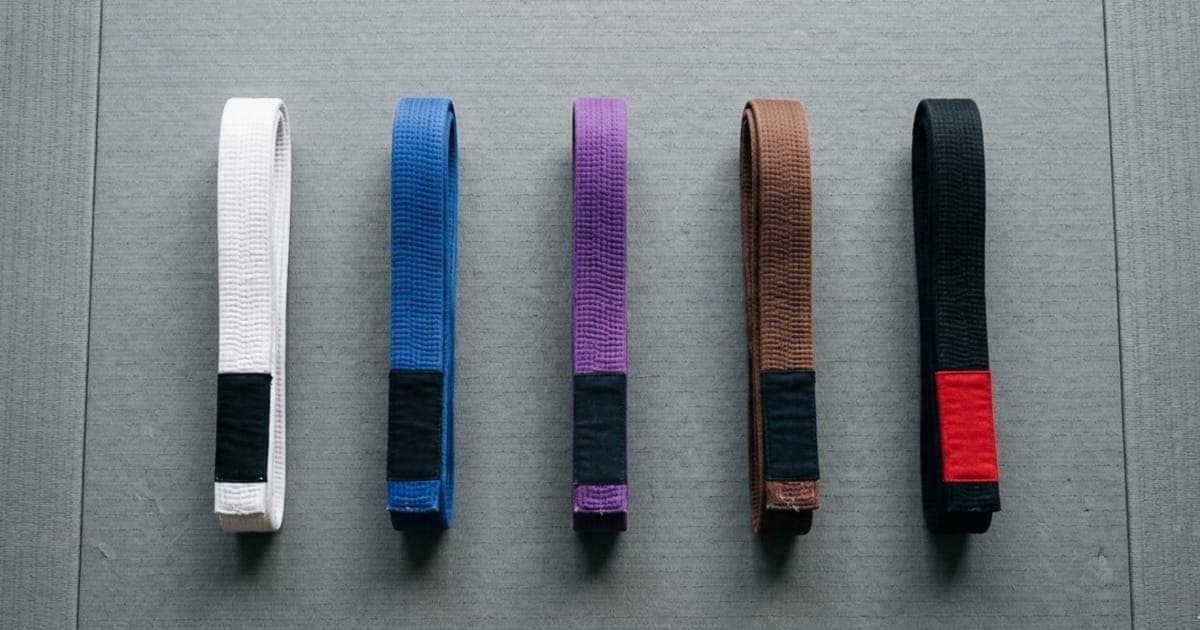
The Brazilian jiu-jitsu ranking system is a sequence of colored belts that tracks your progress from complete beginner to expert. For adults (16 and over) the order is:
- White belt: everyone starts here
- Blue belt: the first “real” rank; you have a functional game
- Purple belt: advanced; you can teach and develop others
- Brown belt: refinement; you’re close to mastery of the fundamentals
- Black belt: expert
Within each of the first four belts you can earn up to four stripes, which mark your progress toward the next belt. And the system doesn’t stop at black. There are degrees on the black belt, and beyond them the coral and red belts reserved for the most senior people in the art.
Those are the basics. Now the details.
How long does it really take to get a BJJ black belt?
For an average hobbyist training two to three times a week at average intensity, a black belt comfortably takes 10 to 15 years. But that number swings enormously based on a handful of variables. And most of them are in your control.
The two that matter most:
- Frequency: how often you train.
- Intensity: how hard you go when you do.
After that:
- The intelligence of your approach: training smart and being given smart approaches by good coaches, versus just showing up and rolling.
- Your physical attributes: age, flexibility, strength, and general athleticism all play a real role.
- Whether you compete: competing, doing well, and training at a competition-focused school can compress the timeline significantly.
- How your academy handles grading: the one big variable you don’t control.
Here’s the honest range:
| How you train | Realistic time to black belt |
|---|---|
| Once a week, low intensity | Up to ~30 years |
| 2–3x per week, average intensity (typical hobbyist) | ~10–15 years |
| High frequency and intensity, smart approach, competing | As little as ~4–5 years |
I’m the bottom row. I earned my black belt in four and a half years. And I want to be very clear about what that does and doesn’t mean.
“Four and a half years? That’s too fast.”
I hear this from the old-school crowd and the online skeptics, and I get the reflex. But a black belt isn’t measured in calendar years. It’s measured in mat hours and demonstrated skill.
I didn’t take a shortcut. I crammed a completely normal number of mat hours into a short window.
I was training up to twice a day, five to seven days a week, at high intensity, with good coaches giving me intelligent approaches. I never once felt unworthy of the belt, because I’d poured my heart and soul into the art and I had the results to back it up.
I was giving brown and black belts a hard time as a purple belt. I won the ADCC trials as a black belt. I was ahead of my belt, not behind it.
The inverse is the one people should actually worry about. The “10-year black belt” who trained twice a week, low intensity, and still can’t perform a clean escape. The calendar says a decade. The skill says otherwise.
Time isn’t the proof. Mat hours and ability are.
What each belt actually means
The governing body for most of the sport, the IBJJF, sets minimum time requirements between belts. Treat these as floors, not norms. Most good instructors take longer.
- White belt: The beginning. No minimum time before blue, but the minimum age to receive a blue belt is 16. This is where the most important moment in your entire journey happens (more on that below).
- Blue belt: Your first real rank. You have a functional, structured game. IBJJF minimum two years at blue before purple.
- Purple belt: Advanced. You can hold your own with almost anyone in the room and you’re capable of teaching. IBJJF minimum 18 months at purple before brown.
- Brown belt: Refinement and polish. Your fundamentals are deep. IBJJF minimum one year at brown before black.
- Black belt: Expert. Minimum age 19. Reaching it is the beginning of a longer, different climb, not the finish.
What the stripes on a BJJ belt mean
Stripes are waypoints, nothing more, and you shouldn’t read more into them than that.
With four stripes available per belt, each stripe represents roughly 20% of the way to your next belt. Your first stripe says you’re about a fifth of the way there. A four-stripe brown belt knows black is close and doesn’t have to second-guess himself.
That’s their entire purpose. To remove the guesswork.
Which is exactly why a school without a clear stripe-and-progression system is a problem. It manufactures the precise “am I being held back?” anxiety that drives people off the mats. When students can see where they stand, they stop reading tea leaves.
The most important grade you’ll ever get (it isn’t the black belt)
Everyone fixates on the black belt. They’re looking at the wrong end of the system.
The most important grade in all of BJJ is the first stripe on your white belt.
When I award it, I tell the student exactly that. Because that stripe proves you didn’t quit at the beginning, and the beginning is the hardest hurdle there is. It’s when training is most uncomfortable, most foreign, and most humbling. Get past it and you’ve cleared the make-or-break moment of your whole jiu-jitsu life.
Most people who are ever going to quit, quit early, somewhere between white and blue. That first visible proof of progress is what keeps a beginner coming back. It’s the same reason a structured curriculum dramatically reduces early dropout.
The kids’ belt system in BJJ
The kids’ system uses more belts than the adult system, and there’s a good reason for it.
Before the adult ranks, children (roughly ages 4–15) progress through additional colors: grey, yellow, orange, and green (each typically with white, solid, and black variations). At 16, they transition into the adult system.
Why so many? Because kids are powerfully motivated by belts and stripes. And honestly, so are adults. The hunger for recognition of progress isn’t that different. More belts means more carrots, and more carrots means more motivation to keep training.
Parents should read the kids’ belts as motivational waypoints, not deep technical gradations. That’s exactly what they’re designed to be.
Beyond black belt: degrees, coral belts, and the red belt
Reaching black belt and realizing it wasn’t the end of the road was one of the best feelings I’ve had in the art.
After black belt come degrees (marked by stripes on the belt) awarded over many years (roughly three years between the first few, then five years each). After the sixth degree, the belts change color again:
- 7th degree: red-and-black belt (the “coral” belt)
- 8th degree: red-and-white belt
- 9th and 10th degree: red belt, reserved for the pioneers who built the art
I was lucky enough to train with Mauricio Gomez (Roger Gracie’s father) when he was already a red-and-white belt, now a coral belt. I was always in awe of his skill and the way he carried himself.
Knowing a level like that still existed above me, that there was always more to chase. That’s what a lifetime in jiu-jitsu actually looks like.
Real belts vs. “paper” belts
A real belt and a paper belt give themselves away within about thirty seconds of rolling, and it has nothing to do with age.
I’ve rolled with genuinely tough, technical black belts in their 50s, and with guys in their early 30s whose belt felt like an attendance trophy. The tell is never flash. It’s fundamentals. The paper black belt doesn’t know a simple escape, his balance is lacking, his posture is crappy. “Real” doesn’t mean you’re a killer. It means the basics are genuinely solid.
This is what belt inflation looks like in practice: students who “have the belt but don’t have the skills to back it up.” It usually comes from one bad habit: grading purely on attendance. Show up enough times, get promoted. People slip through the cracks, and the belt stops meaning what everyone assumes it means.
A word on sandbagging
Sandbagging (keeping a student down a belt so they can keep winning medals in a division they’ve clearly outgrown) is ridiculous.
I completely understand not promoting someone who genuinely isn’t ready. That’s good coaching. But deliberately holding a purple belt back for four years so he can win Worlds as a purple belt? That exists to inflate the student’s ego and the school owner’s ego, and nothing else.
And the logic doesn’t even hold up. There’s nowhere to go above black belt. If you actually want to compete at the highest level, you eventually have to compete at black belt anyway. Dragging out the lower belts to farm medals buys you nothing but a trophy shelf and a reputation. That’s ego, not development.
“Am I being held back?”: how to actually tell
This is the question I get most, and the honest answer has some nuance to it.
If your school grades using real systems and data (and your coach layers instinct on top of it) the feeling that you’re being held back is almost always your ego talking. A good coach holds you back precisely because he can see your skill doesn’t yet match the belt you want.
Ask yourself three questions:
- Do I trust my coach?
- Do they have systems in place, is grading run off data and a clear progression, not a whim?
- Am I genuinely worthy of the next belt?
If grading is systematic and instinct-informed, sit with those answers honestly. In rare cases it is legitimate: a coach grading on a whim, or worse, on a personal dislike of a particular student. If that’s genuinely what’s happening, it’s time to find a new school. But investigate before you walk. Really look around and ask those three questions first.
The deeper issue, though, is this. Most of this anxiety is manufactured by a lack of visible progression. When a student can’t see where they stand, they invent a story. Usually a negative one.
When they can see their attendance, their curriculum progress, and how close they are to the next stripe, the guesswork disappears and the resentment never forms. That visibility is one of the core reasons I built GRADR. So students stop reading tea leaves and coaches grade from a clear picture instead of memory.
For academy owners: grading that scales without becoming a McDojo
If you run an academy, the belt system is also an operations problem, and it’s easy to get wrong in two opposite directions.
One is grading purely on attendance or raw numbers. That’s the McDojo trap: data with no judgment, and belt inflation as the result. The other is grading purely on a whim, with no records and no consistency, which breeds exactly the resentment and “am I being held back?” anxiety we just covered.
The gold standard sits in the middle: data as the baseline, instructor instinct and nuance on top. You grade from real attendance and curriculum data, and then you apply the judgment that only a coach on the mats can provide. That’s how grading stays fair, consistent, and trustworthy as you grow from twenty students to two hundred.
Doing that by memory and spreadsheets falls apart fast. Purpose-built BJJ gym management software (attendance tracking, curriculum, and belt-and-stripe grading in one place) gives you the baseline layer, so the judgment layer is the only thing you have to think about.
See it in action. Book a GRADR demo and we’ll show you how attendance, curriculum, and belt-and-stripe grading come together, so every promotion is backed by data and your judgment.
The truth nobody tells you about belts
After all of that, here’s the one thing I most want a brand-new white belt to hold onto.
For many years, focus on the journey, not the destination.
We all carry this quiet, mistaken belief that getting to the next belt will change everything. It changes things for about a week. You stand a little prouder, you hold your head a little higher, you get bumped into a different competition bracket, you get some praise.
Then the high wears off, and everything else is still there. Your problems, your challenges, on and off the mats, all of it, waiting exactly where you left it.
A belt is a fine yardstick of your improvement, but measuring yourself is not why you train. Put your attention on the relationships you make, what you learn about yourself, and the fun you have along the way.
That’s the part that lasts long after the color of your belt stops mattering to you.
Frequently asked questions
How long does it take to get a BJJ black belt?
It depends. Mostly on how often and how hard you train, plus how intelligently you train, your physical attributes, whether you compete, and how your school grades. An average hobbyist training 2–3x a week should reach black belt comfortably in 10–15 years. Train at high frequency and intensity and it can be far less. Train once a week at low intensity and it can take up to 30 years.
Can you really get a BJJ black belt in under five years?
Yes, but not by skipping anything. Only by compressing a normal number of mat hours into a short window. I earned mine in four and a half years training up to twice a day, five to seven days a week, and backed it up in competition. Time isn’t the proof; mat hours and demonstrated skill are.
What do the stripes on a BJJ belt mean?
They’re waypoints. With four stripes per belt, each stripe is roughly 20% of the way to the next belt. Don’t over-read them. They exist to show progress and remove guesswork.
What is the kids’ belt system in BJJ?
Children progress through additional colors (grey, yellow, orange, and green, each with variations) before entering the adult belts at 16. The extra ranks exist to give kids more frequent motivation. Read them as encouragement milestones, not deep technical rankings.
What’s the most important belt or grade in BJJ?
Counterintuitively, the first stripe on the white belt. It proves you didn’t quit at the beginning: the hardest, most uncomfortable, and most unfamiliar stage of the entire journey.
What comes after black belt?
Degrees on the black belt, awarded over many years, then the red-and-black (coral) belt at 7th degree, the red-and-white belt at 8th, and the red belt at 9th and 10th degree. Black belt is not the end of the road.
How can I tell if my coach is holding me back?
Ask three questions: Do I trust my coach? Does he grade off systems and data rather than a whim? Am I genuinely worthy of the next belt? If grading is systematic and instinct-informed, the feeling is usually ego. If it’s run on a whim or a personal grudge, that’s a legitimate reason to look elsewhere, but investigate honestly before you leave.
Nic Gregoriades is a fourth-degree Brazilian jiu-jitsu black belt and the first person ever to receive a black belt from Roger Gracie. He is the co-founder of the Jiu-Jitsu Brotherhood and the founder of GRADR, gym management software built specifically for BJJ academies. He has trained and coached for more than 27 years across four continents.