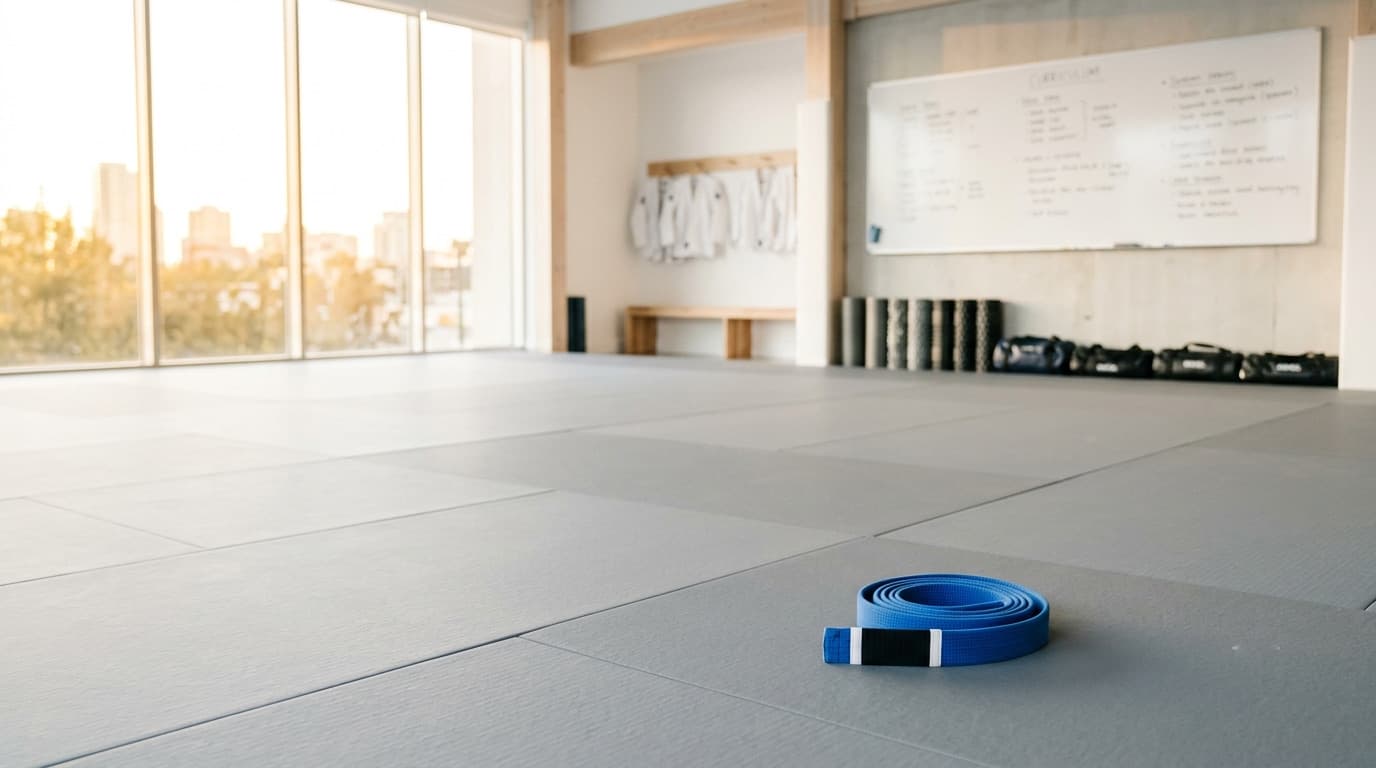
Walk into most jiu-jitsu academies on a Tuesday night and ask the instructor what they’re teaching.
Nine times out of ten the answer is some version of “I’ll figure it out when I get on the mat.”
I know this because I did it for years. I’d show up, feel the room, and teach whatever was on my mind that day. A guard pass on Monday. A wrist lock I’d been playing with on Wednesday. Some berimbolo thing I saw on Instagram on Friday.
It feels like teaching. The students are sweating, they’re learning moves, everybody goes home happy.
But it isn’t a curriculum. It’s improvisation with a black belt on.
And here’s the problem with improvisation: it lives and dies with you. The day you’re sick, or traveling, or you finally take a holiday, the whole thing falls apart. The only place the syllabus exists is inside your head.
A great instructor doesn’t build a great school. A great system does.
Nobody wants to hear this part.
We tell ourselves the academy succeeds because of the quality of the head coach. The lineage. The mat presence. And sure, that matters. But it’s also the trap. If the school only works when you’re the one teaching, you don’t own an academy. You own a job that you can never leave.
A curriculum is the thing that fixes that.
It’s the difference between “Professor taught me a triangle once” and “every white belt here learns the same triangle, the same way, in their first eight weeks, whether I’m on the mat or my purple belt is covering.” It’s how a student who trains Monday-Wednesday-Friday and a student who trains Tuesday-Thursday end up at the same place. It’s how you promote people on what they actually know instead of who you happened to remember.
I wrote a whole piece on this idea, running the academy as a system instead of a personality, over here. The curriculum is the engine room of that system. So let’s build one.
Start with the spine, not the techniques
The mistake almost everyone makes is starting with a list of moves. Two hundred techniques in a spreadsheet, sorted by belt.
Don’t do that. You’ll drown, and so will your students.
Start with the spine. In jiu-jitsu the spine is positional hierarchy, the order of priorities that decides what matters when. I learned this the hard way training under Roger, and it got hammered home by the way Saulo Ribeiro framed it: you don’t win by collecting submissions. You win by being impossible to beat first, and dangerous second.
The hierarchy goes like this:
- Survive. Don’t get finished. Defend the choke, defend the armbar, breathe.
- Escape. Get out of bad positions. Side control, mount, back.
- Guard. If you’re on the bottom and safe, learn to play and recover guard.
- Pass. Get past the legs into a dominant position.
- Dominate. Establish and hold mount, side control, the back.
- Submit. Finish, last.
Build your curriculum in that order and something beautiful happens: a brand-new white belt spends their first months learning the things that actually keep them training (surviving and escaping) instead of getting smashed, getting hurt, and quitting.
Most academies teach this exactly backwards. They open with submissions because submissions are sexy. Then they wonder why their white belt washout rate is brutal.
Defense first. Always.
A white-belt curriculum skeleton
Here’s a concrete starting point. A full white-belt-to-blue-belt syllabus organized by position, not by technique soup. Steal it, adapt it, make it yours. The point isn’t that these are the only right techniques. The point is that there’s a structure.
Block 1: Survival & Escapes (the first stripe)
- Posture, frames, and the “shrimp” hip escape
- Surviving and escaping the mount (trap-and-roll, elbow-knee escape)
- Surviving and escaping side control (frame, shrimp, recover guard)
- Back defense: protect the neck, fight the hands, escape the back
- Standing up safely in a fight (technical stand-up)
Block 2: Closed Guard (the second stripe)
- Maintaining closed guard, posture control, breaking the posture
- Three submissions: cross-collar choke, armbar, triangle
- One sweep: the scissor sweep or hip-bump
- The fundamental open-guard recovery when they stand
Block 3: Guard Passing (the third stripe)
- Posture and grips inside the closed guard, opening the guard safely
- One pressure pass (knee-cut or over-under)
- One speed pass (toreando)
- Passing to a dominant position, not just past the legs
Block 4: Top Control & Submissions (the fourth stripe)
- Holding mount and side control under pressure
- Taking the back from mount and side control
- The mounted cross-collar choke and the armbar from mount
- The rear naked choke and bow-and-arrow from the back
Block 5: Putting it together (blue-belt readiness)
- Takedown fundamentals: one wrestling shot, one judo throw, guard pull
- Linking it all: survive, escape, recover or sweep, pass, dominate, finish
- Positional sparring against each block, live
That’s roughly a year of structured, repeatable material for a three-day-a-week student. It maps cleanly onto four stripes and a blue belt. And every coach in your building can teach it without reading your mind.
Structure the class, not just the syllabus
A curriculum tells you what to teach over months. A class structure tells you how to teach it tonight. You need both.
A format that works for almost any academy:
- Warm-up that’s actually jiu-jitsu (10 min): movements from the curriculum, not just jumping jacks
- Technique of the day from the current block (15 min)
- Drilling the technique with progressive resistance (15 min)
- Positional sparring from that exact position (15 min)
- Open rolling (15-20 min)
The magic is in the connection. The position you drilled is the position you spar. The white belt doesn’t learn an armbar in a vacuum and then go get smashed in unrelated free-rolling. They drill the armbar from closed guard, then spar starting in closed guard. The lesson sticks because the night was built around it.
Write the format down. Print it. Put it on the wall. Every instructor runs the same shape, so every class feels like the same school, not five different schools depending on who’s coaching.
Tie the curriculum to the stripes
This is where the curriculum stops being a teaching tool and becomes a promotion tool.
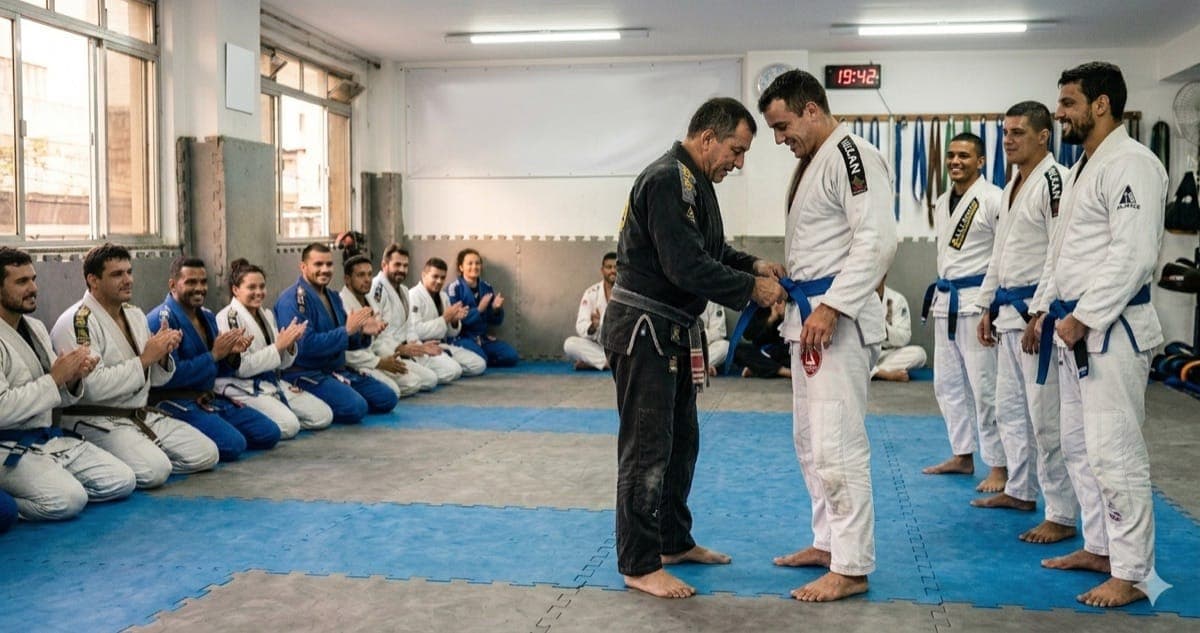
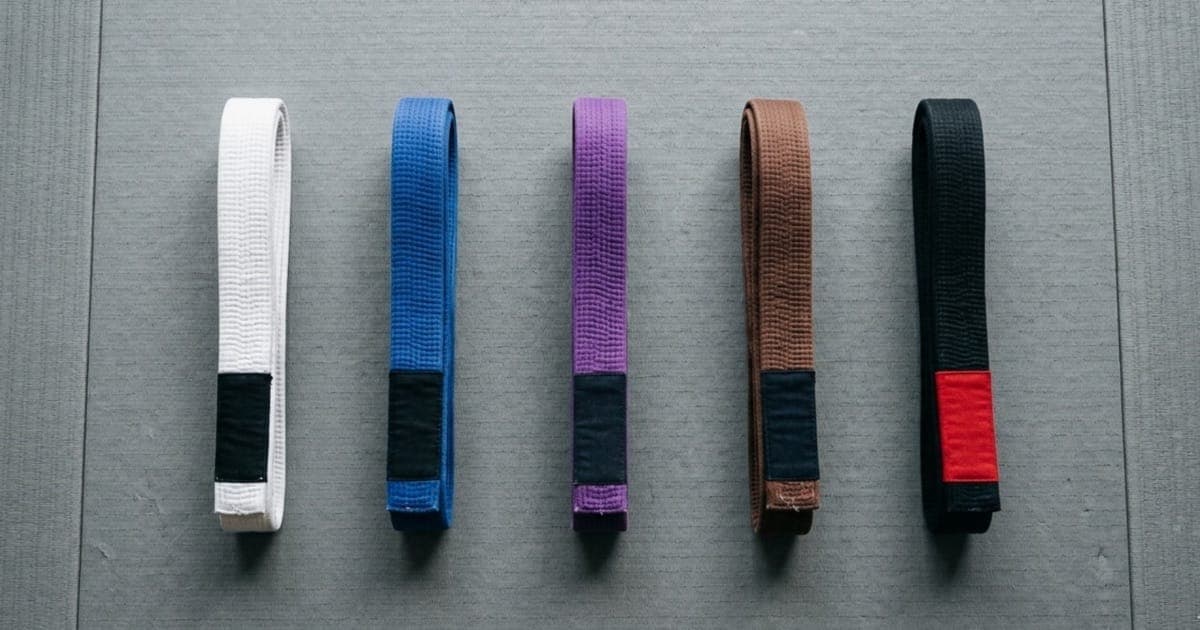
When your syllabus is built in blocks, the belt system almost writes itself. A stripe means “this person has been shown, has drilled, and can demonstrate this block under resistance.” Promotions stop being a gut feeling and start being a standard.
I’m not saying turn it into a checklist that ignores the human in front of you. Jiu-jitsu isn’t a driving test, and there’s an art to grading that no spreadsheet replaces. I went deep on that balance in the piece on running gradings that scale without becoming a McDojo. Read that one next.
But the curriculum gives you the baseline. The objective floor. Your judgment lives on top of it. It doesn’t have to carry the whole thing alone.
The part that breaks: keeping track of it all
Everything above is achievable with a whiteboard and discipline, right up until you have a real number of students.
Then it falls apart.
Picture it. A hundred and fifty members. Five instructors. Five blocks of curriculum. Students who train wildly different schedules. Now answer me this, off the top of your head: which of your blue belts has actually been shown the back-take series? Has the Tuesday-Thursday crowd covered guard passing yet, or did that block only run on the nights they don’t train? Who’s due a stripe and hasn’t been graded because nobody was tracking it?
You can’t answer. Nobody can answer that from memory. So the curriculum that exists on paper quietly stops matching the curriculum that’s actually being delivered, and you’re right back to improvisation, just with more steps.
This is the exact problem I built GRADR to solve. You put your curriculum in once (your blocks, your lessons, your positions) and you assign and track it against every student in the building. You can see who’s covered what, who’s ready for the next stripe against your own standard, and which parts of the syllabus haven’t run in a while. The curriculum stops being a document you wrote and forgot. It becomes the thing your academy actually runs on.
If you’re at the point where the whiteboard isn’t cutting it anymore, that’s what GRADR is for. You can see how it works here. And if you’re still shopping around, I wrote an honest comparison of the BJJ software out there, including the stuff that isn’t us.
Build the engine
You don’t need to be a better instructor to build a better academy. You need a system that doesn’t depend on you being in the room.
A curriculum is the first brick. Build the spine, fill the blocks, structure the class around them, and tie it to the belts. Do that and you’ve turned the thing in your head into something your whole team can teach, and something your students can actually count on.
That’s not bureaucracy. That’s the difference between a hobby with a logo and a school that outlives you.
Build the engine.
Frequently asked questions
What should a BJJ white belt curriculum cover?
Defense and escapes first (surviving and escaping mount, side control, and the back) before any submissions. From there: closed guard (a couple of submissions and a sweep), basic guard passing, top control, and finally finishes from dominant positions. A white belt who can survive and escape will keep training. One who only learns flashy submissions tends to get smashed and quit.
How do you structure a BJJ curriculum?
Start with the positional hierarchy (survive, escape, guard, pass, dominate, submit) and build blocks of material in that order rather than starting with a list of techniques. Map each block to a stripe so the curriculum and the belt system reinforce each other.
How long should a BJJ curriculum take to get from white to blue belt?
For a student training around three times a week, a well-structured five-block curriculum is roughly a year to eighteen months of material. But time on the mat isn’t the standard, demonstrated competence under resistance is. The curriculum gives you the baseline; your judgment as a coach decides the actual promotion.
Do I need software to run a BJJ curriculum?
No, a whiteboard and discipline work fine for a small room. The trouble starts when you have many students, multiple instructors, and mixed schedules, and you can no longer track from memory who has covered what. That’s the point where curriculum-tracking software like GRADR earns its place.
What’s the difference between a curriculum and a lesson plan?
A curriculum is the full syllabus your academy teaches over months: the blocks of material and the order you teach them. A lesson plan is the structure of a single class. You want both: the curriculum keeps the school consistent across instructors, and the lesson plan keeps each individual night focused.
Nic Gregoriades is a fourth-degree Brazilian jiu-jitsu black belt and the first person ever to receive a black belt from Roger Gracie. He is the co-founder of the Jiu-Jitsu Brotherhood and the founder of GRADR, gym management software built specifically for BJJ academies. He has trained and coached for more than 27 years across four continents.